One Eye Industries · Magnetic Filtration
The damage you cannot see,
in the fluid you cannot clean.
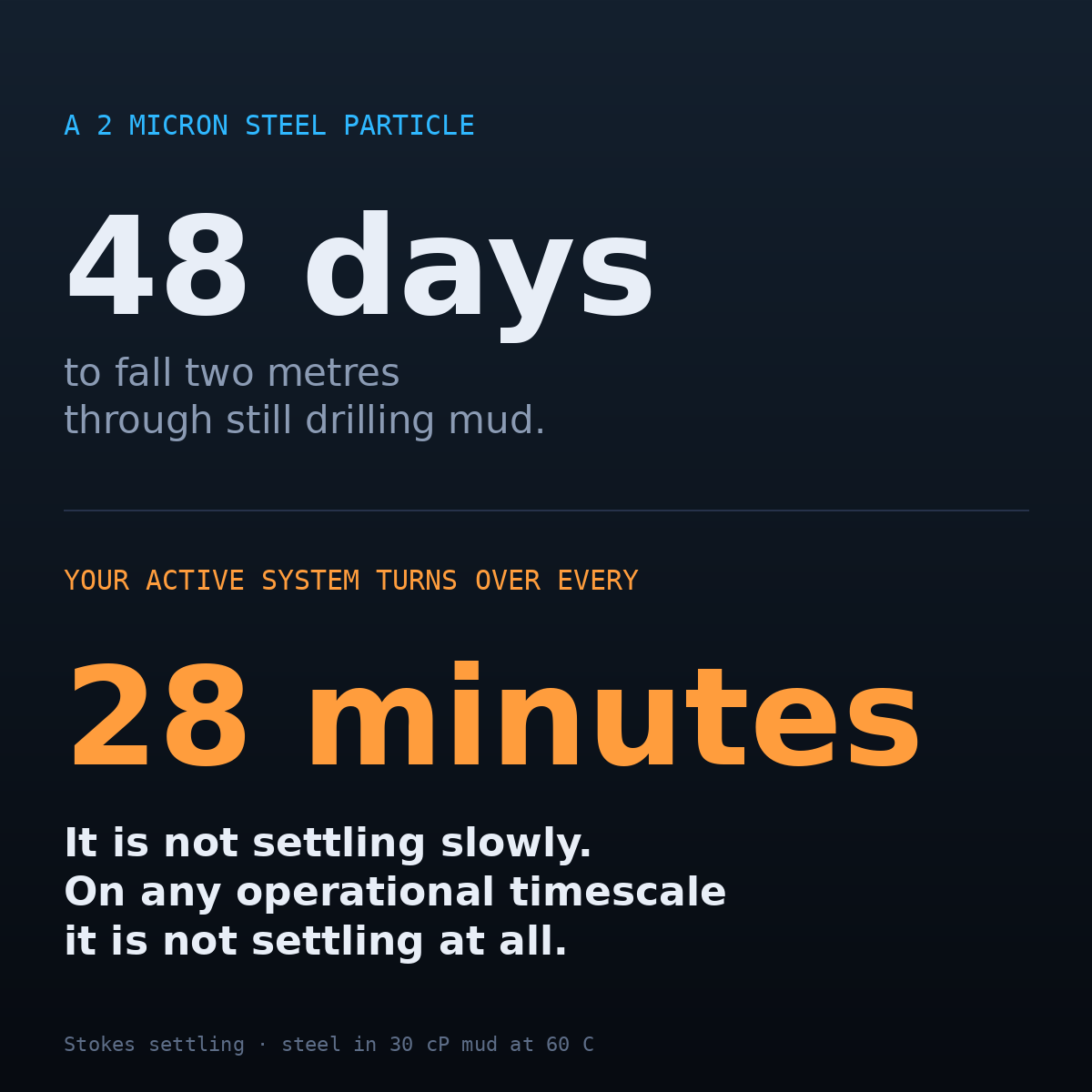
Below about four microns, ferrous wear debris stops behaving like a solid and starts behaving like part of the fluid. Gravity does not remove it. Settling tanks do not remove it. Centrifuges do not remove it. Media filters cannot remove it without stripping out the barite you paid for. It circulates, and it keeps cutting.
Take it away
PDFs only. Nothing here carries active content, so it will survive a corporate mail gateway.
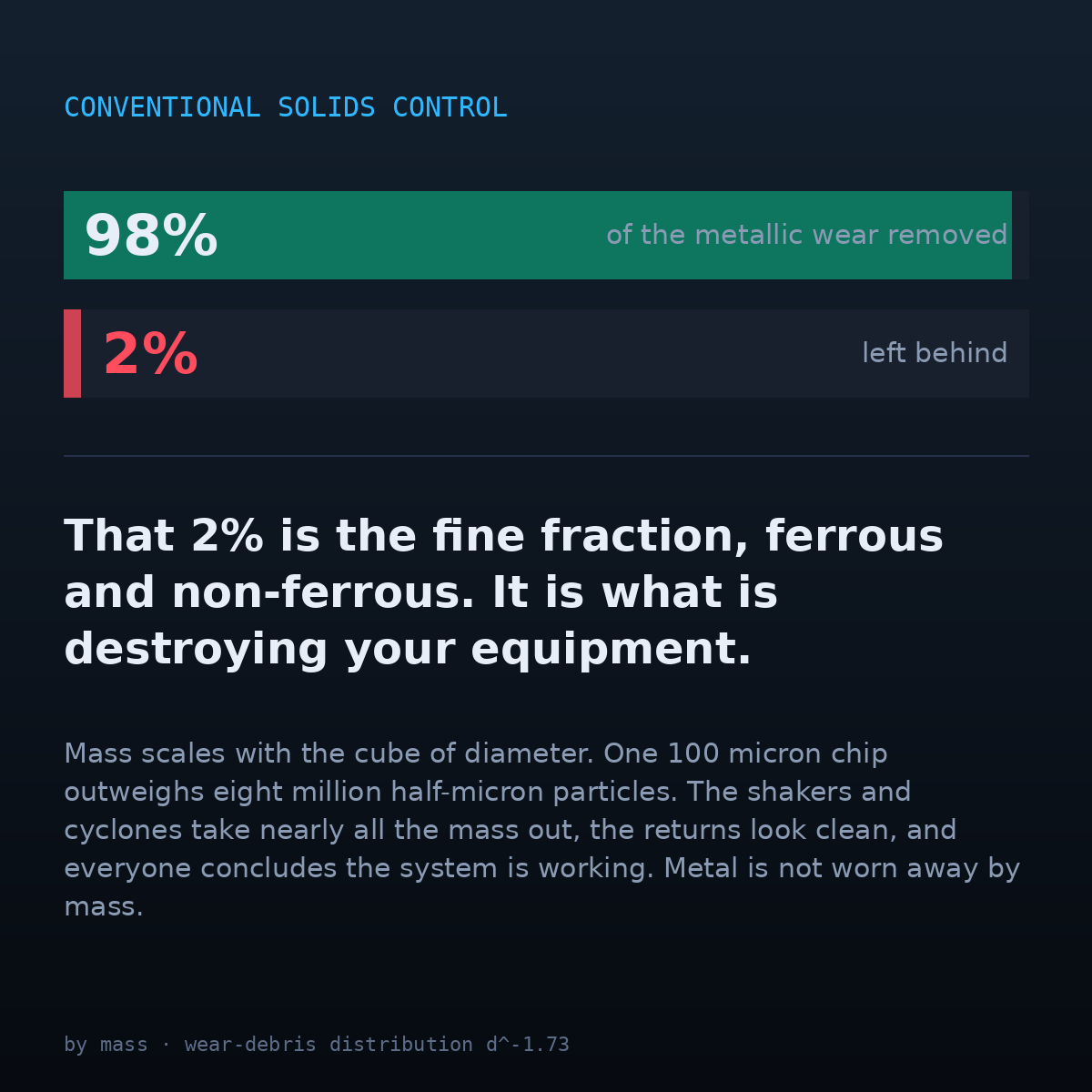
Conventional solids control removes 98% of the metallic wear
and leaves the 2% that does the damage.
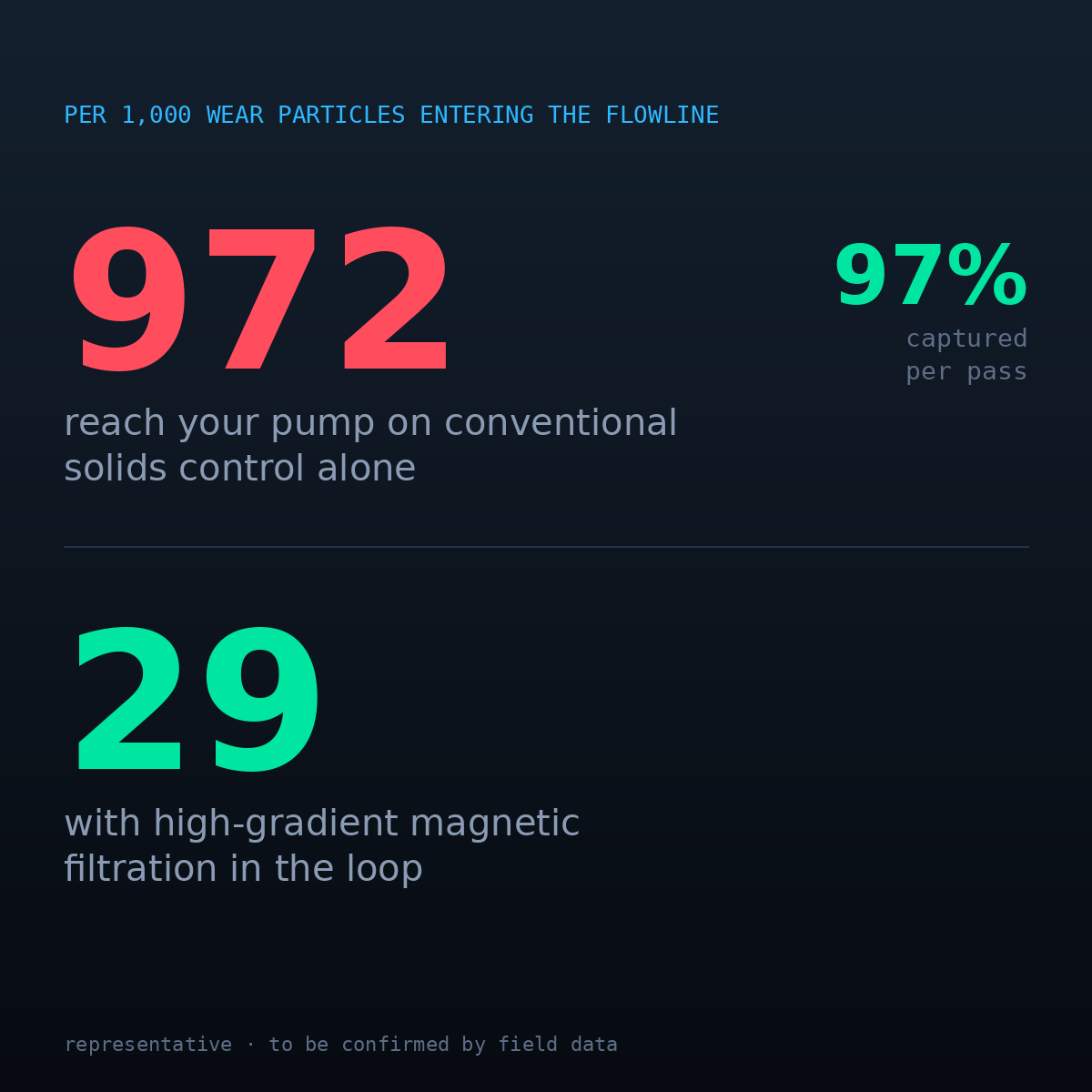
Mass scales with the cube of diameter, so one 100 micron chip outweighs eight million half-micron particles. The shakers and cyclones take nearly all of that mass out, the returns look clean, and everyone concludes the system is working. Metal is not worn away by mass. It is worn by the number of hard particles small enough to enter a running clearance.
Basis. Stokes' law terminal velocity at Reynolds number below 1; Stokes–Einstein diffusion for Brownian displacement; magnetic body force balanced against Stokes drag. Steel 7,800 kg/m³, mud 1,200 kg/m³ at 30 cP and 60 °C. Cascade order per Rabia (2001) and Hossain & Al-Majed (2015), validated against a generic P&ID. Cut points are industry-typical ranges and vary by make, screen, feed and operating condition. Counts weighted to a wear-debris size distribution of d−1.73; the defensible range is 1.5 to 3 and the answer moves materially across it. Capture per pass is a property of the unit, not of the rig. Performance and financial figures are vendor field and demonstration data, representative and illustrative, to be confirmed by field data. Not a guaranteed result.